
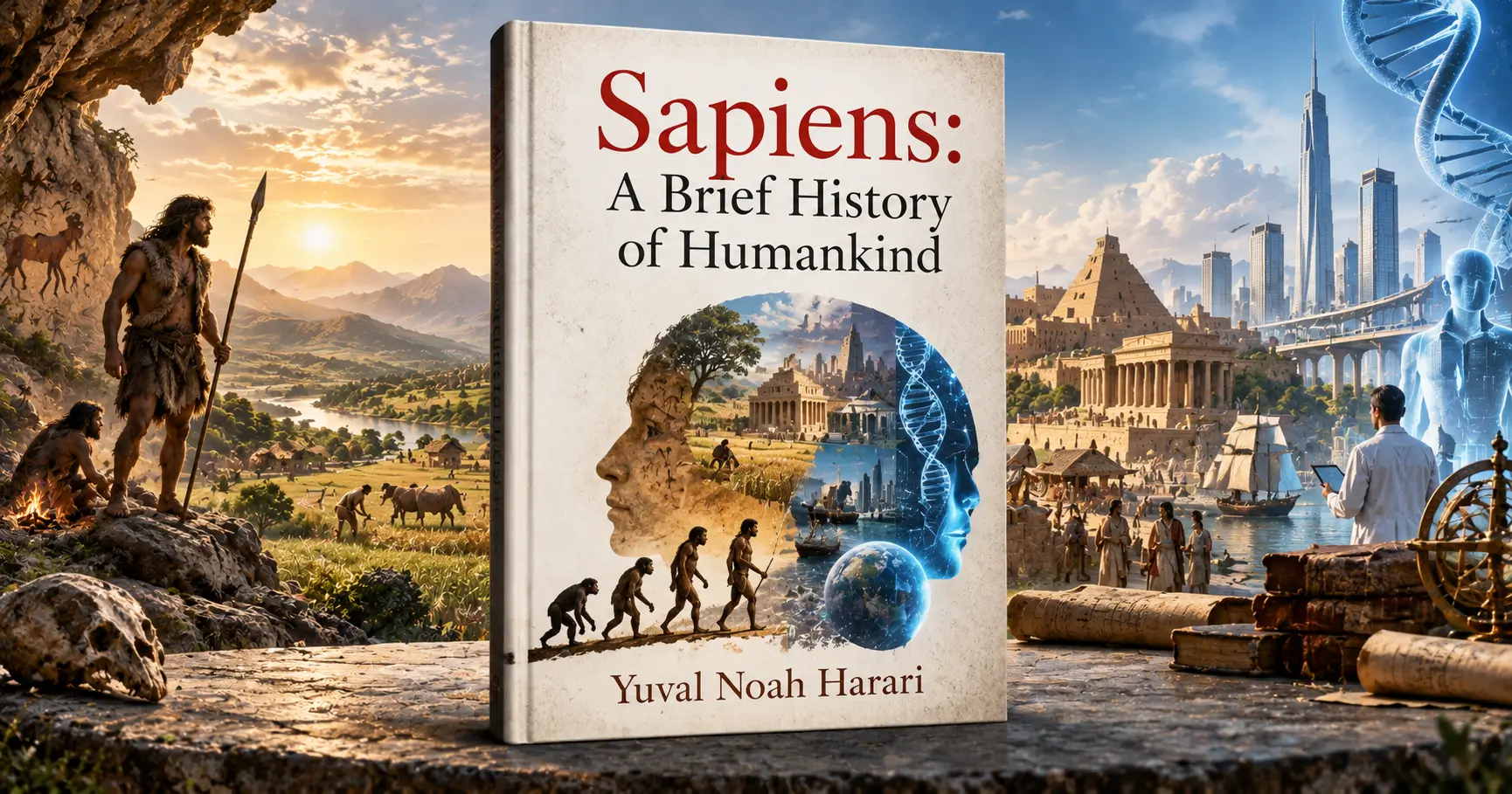
Sapiens: A Brief History of Humankind PDF Book Download by Yuval Noah Harari
Book Short Summaries with Lessons
Introduction: What Makes Homo Sapiens Different?
Sapiens: A Brief History of Humankind PDF Book examines how Homo sapiens developed from one human species among several into the dominant species on Earth. Yuval Noah Harari combines history, anthropology, biology, economics, and philosophy to explore the major transformations that shaped human societies.
The book is organized around four broad historical developments: the Cognitive Revolution, Agricultural Revolution, Unification of Humankind, and Scientific Revolution. Harari repeatedly asks whether greater human power has necessarily produced greater happiness and whether technological progress should automatically be considered human progress.
Part One: The Cognitive Revolution
Chapter 1: An Animal of No Significance
Harari begins by placing Homo sapiens within the wider history of life and the human species. Humans were not always the dominant force on Earth. Several human species once existed, but only Homo sapiens survived.
The chapter emphasizes that biological strength alone cannot explain our success. Human beings became unusually powerful because of their capacity for cooperation and flexible communication.
Lesson: Human dominance is closely connected to collective intelligence and cooperation, not simply physical strength.
Chapter 2: The Tree of Knowledge
This chapter explores the Cognitive Revolution, which Harari associates with major changes in human thinking and communication around 70,000 years ago.
Human language enabled people to communicate about more than immediate physical objects. They could discuss social relationships, dangers, distant places, traditions, imagined beings, and shared rules.
This ability allowed much larger groups of humans to cooperate.
Lesson: Shared stories and ideas can organize people on a scale that individual relationships alone cannot achieve.
Chapter 3: A Day in the Life of Adam and Eve
Harari reconstructs aspects of hunter-gatherer life and challenges the assumption that prehistoric humans simply lived primitive and miserable lives.
Hunter-gatherers possessed detailed environmental knowledge and adapted to different landscapes. Their lives varied considerably depending on geography, climate, food availability, and social organization.
The chapter also reminds readers that modern assumptions about family, gender, diet, and daily life cannot simply be projected backward onto prehistoric societies.
Lesson: The human past was more diverse and complex than the simple image of “primitive people” suggests.
Chapter 4: The Flood
Harari examines the expansion of Homo sapiens across the planet and its consequences for other animals.
As humans entered new environments, they became powerful hunters and environmental agents. The disappearance of numerous large animal species is discussed as part of the broader ecological consequences of human expansion.
Lesson: Human success has always had environmental consequences, and our relationship with nature is a central part of human history.
Part Two: The Agricultural Revolution
Chapter 5: History’s Biggest Fraud
The Agricultural Revolution transformed human societies as people increasingly cultivated crops and domesticated animals.
Agriculture supported larger populations and permanent settlements, but Harari argues that this should not automatically be described as an improvement in individual quality of life. Farming could involve harder labor, narrower diets, disease exposure, and dependence on particular crops.
Harari famously reverses the conventional perspective by suggesting that humans changed their lives dramatically for the benefit of domesticated plants and animals.
Lesson: Population growth and species-level success do not necessarily mean better lives for individual people.
Chapter 6: Building Pyramids
As agricultural populations expanded, humans created larger communities, political structures, monuments, and systems of administration.
Harari explains how enormous projects could be achieved because people accepted shared social orders and collective goals. Civilizations could mobilize thousands of people through common beliefs about kings, gods, societies, and institutions.
Lesson: Shared beliefs can make large-scale cooperation possible.
Chapter 7: Memory Overload
Large societies generated enormous amounts of information about taxes, property, trade, harvests, populations, and administration.
Writing and numerical systems became increasingly important because human memory could not manage the complexity of expanding bureaucracies.
Lesson: Civilization requires systems for storing and organizing information as societies become more complex.
Chapter 8: There Is No Justice in History
Harari examines social hierarchies and inequality. Agricultural societies created distinctions based on wealth, gender, class, ethnicity, occupation, and political status.
He argues that many hierarchies are maintained because societies collectively accept particular ideas about what is natural, legitimate, or deserved.
Lesson: Social inequality is often supported by cultural beliefs and institutions rather than being an unavoidable law of nature.
Part Three: The Unification of Humankind
Chapter 9: The Arrow of History
Harari explores how societies gradually became interconnected despite enormous differences in culture and geography.
He identifies a long-term movement toward larger systems of cooperation and shared identity.
Lesson: Human history involves both cultural diversity and increasing interconnectedness.
Chapter 10: The Scent of Money
Money becomes one of the most powerful systems for connecting strangers.
People can trade because they trust that others will recognize the value of money. This makes money a universal mechanism of cooperation that can cross religious, cultural, and geographic boundaries.
Lesson: Economic cooperation depends heavily on shared trust.
Chapter 11: Imperial Visions
Empires played a major role in spreading languages, laws, religions, technologies, and political systems across large territories.
Harari presents empire as a complex historical force. Imperial expansion often involved violence and exploitation, but it also created cultural integration and lasting institutions.
Lesson: Historical institutions can produce both destruction and long-term integration.
Chapter 12: The Law of Religion
Harari examines religion as a system capable of organizing large populations around shared moral and social beliefs.
He discusses different religious traditions and the ways religions created common values that could extend beyond small communities.
Lesson: Religion has been an important mechanism for large-scale human cooperation and social organization.
Chapter 13: The Secret of Success
The chapter brings together the forces that helped different civilizations interact and merge.
Harari emphasizes that there is no single simple formula explaining historical success. Biological, cultural, economic, political, and geographical forces interacted over time.
Lesson: Human history is produced by interacting systems rather than one universal cause.
Part Four: The Scientific Revolution
Chapter 14: The Discovery of Ignorance
Harari argues that modern science was strengthened by the willingness to admit that important things were unknown.
Scientific investigation relies on observation, measurement, experimentation, mathematics, and the possibility of correcting existing knowledge.
Lesson: Recognizing ignorance can become a powerful source of discovery.
Chapter 15: The Marriage of Science and Empire
Scientific exploration developed alongside European expansion, trade, and imperialism.
Knowledge about geography, navigation, medicine, natural resources, and technology strengthened imperial powers, while imperial expansion also created opportunities and incentives for scientific investigation.
Lesson: Science does not develop in isolation; it interacts with politics, economics, and power.
Chapter 16: The Capitalist Creed
Harari explains how modern capitalism relies heavily on credit, investment, economic growth, and confidence in the future.
Capitalism encouraged people to invest resources today with the expectation that future production would create greater wealth.
Lesson: Modern economies depend not only on existing wealth but also on trust in future growth.
Chapter 17: The Wheels of Industry
The Industrial Revolution transformed production through machines, fossil fuels, factories, transportation, and increasingly complex economic systems.
Production became less dependent on traditional biological energy sources and increasingly dependent on industrial energy.
Lesson: Energy and technology fundamentally changed the scale and speed of human economic activity.
Chapter 18: A Permanent Revolution
Modern society introduced continuous and rapid changes in technology, family structures, political systems, consumer habits, and everyday life.
Harari also examines how industrial society created new forms of organization, discipline, and mass consumption.
Lesson: Modern life is defined by continuous change rather than stability.
Chapter 19: And They Lived Happily Ever After
Harari asks whether all the changes described throughout history actually made humans happier.
Greater wealth, technology, medicine, and material comfort do not provide a simple answer because happiness is influenced by expectations, social relationships, culture, biology, and personal experience.
Lesson: Human progress should not be measured only through technological or economic power.
Chapter 20: The End of Homo Sapiens
The final chapter considers humanity’s potential future.
Biotechnology, genetic engineering, and other technologies may eventually allow humans to modify biological characteristics that were previously considered fixed.
Harari asks whether Homo sapiens will remain essentially the same species or whether humans may eventually create new forms of life and intelligence.
Lesson: Humanity’s greatest future challenge may be deciding what to do with the extraordinary power it has acquired.
Afterword: The Animal That Became a God
The book closes by reflecting on the paradox of human history. Homo sapiens has acquired extraordinary control over the environment and other species, yet humans still face fundamental questions about happiness, purpose, ethics, and the direction of their civilization.
The central challenge is therefore not simply how much power humanity can gain, but how wisely that power will be used.
Main Points and Lessons from Sapiens
- Human cooperation is a defining advantage. Large groups can coordinate through shared ideas and institutions.
- Stories shape societies. Nations, money, laws, religions, and organizations depend on collectively accepted concepts.
- Agriculture changed everything. It enabled larger populations and settlements but also introduced new hardships and inequalities.
- Progress is complicated. Greater technology and wealth do not automatically guarantee greater happiness.
- Money creates cooperation among strangers. Its power comes from collective trust.
- Empires reshaped the world. They often involved violence while also spreading institutions and cultures.
- Science begins with recognizing ignorance. Modern investigation depends on questioning existing knowledge.
- Capitalism depends on confidence in the future. Credit and investment allow economies to expand.
- Technology increases human power. Industrial and scientific developments transformed the relationship between humans and nature.
- The future creates a new responsibility. Biotechnology and advanced technology may allow humans to redesign life itself.
Book Information
| Book Title | Sapiens: A Brief History of Humankind |
|---|---|
| Author | Yuval Noah Harari |
| Published | 2014 |
| Genre | History / Anthropology / Nonfiction |
| Pages | 443 pages |
| Language | English |
The 2014 English edition published by Harvill Secker is catalogued by the Hebrew University of Jerusalem as 443 pages, while other editions have different pagination.
About the Author
Yuval Noah Harari is a historian and author whose work focuses on broad questions connecting history, biology, society, and technology. He holds a PhD in History from the University of Oxford and lectures at the Hebrew University of Jerusalem. His major books include Sapiens, Homo Deus, and 21 Lessons for the 21st Century. Sapiens established him as an internationally recognized writer on human history and civilization.
FAQ
Q1. What is Sapiens: A Brief History of Humankind about?
Sapiens: A Brief History of Humankind explores the history of Homo sapiens, from early human societies through agriculture, empire, religion, capitalism, science, industrialization, and possible future technological transformation.
Q2. Who wrote Sapiens?
Sapiens: A Brief History of Humankind was written by historian and author Yuval Noah Harari.
Q3. What are the main revolutions discussed in Sapiens?
The book focuses on the Cognitive Revolution, Agricultural Revolution, and Scientific Revolution, while also examining the historical unification of humankind through systems such as money, empire, and religion.
Q4. What is the main idea of Sapiens?
A central idea is that Homo sapiens became extraordinarily powerful because humans can cooperate in very large numbers through shared beliefs, stories, institutions, and social systems.
Q5. What does Sapiens say about the Agricultural Revolution?
Harari argues that agriculture dramatically increased human populations and enabled permanent settlements, but it did not necessarily make individual human lives easier or happier.
Q6. Why is money important in Sapiens?
Money is presented as a powerful system of shared trust that allows strangers from different cultures and regions to cooperate economically.
Q7. What does Sapiens say about science?
Harari emphasizes the importance of recognizing ignorance and using systematic investigation to expand human knowledge. He also examines the relationship between science, empire, economics, and political power.
Q8. Does Sapiens discuss the future of humanity?
Yes. The final section considers biotechnology, genetic engineering, and other technologies that could eventually transform human biology and raise difficult questions about the future of Homo sapiens.
Q9. How many pages does Sapiens have?
The 2014 Harvill Secker English edition is catalogued at 443 pages. Pagination differs between editions and formats.
Q10. Is a free official PDF of Sapiens available?
No legitimate free full-text PDF was verified from the author’s official website or an authorized publisher source. Readers should use legitimate publisher, retailer, library, or authorized ebook options rather than unauthorized PDF copies.
Disclaimer
This page contains an original summary and educational explanation of Sapiens: A Brief History of Humankind by Yuval Noah Harari. It does not reproduce the original book and is not a substitute for reading the complete work. The original book, cover artwork, trademarks, and copyright remain the property of their respective rights holders. Book information may vary between editions, publishers, formats, and translations.