
Sapiens: A Brief History of Humankind — Book Summary, Key Ideas and Lessons
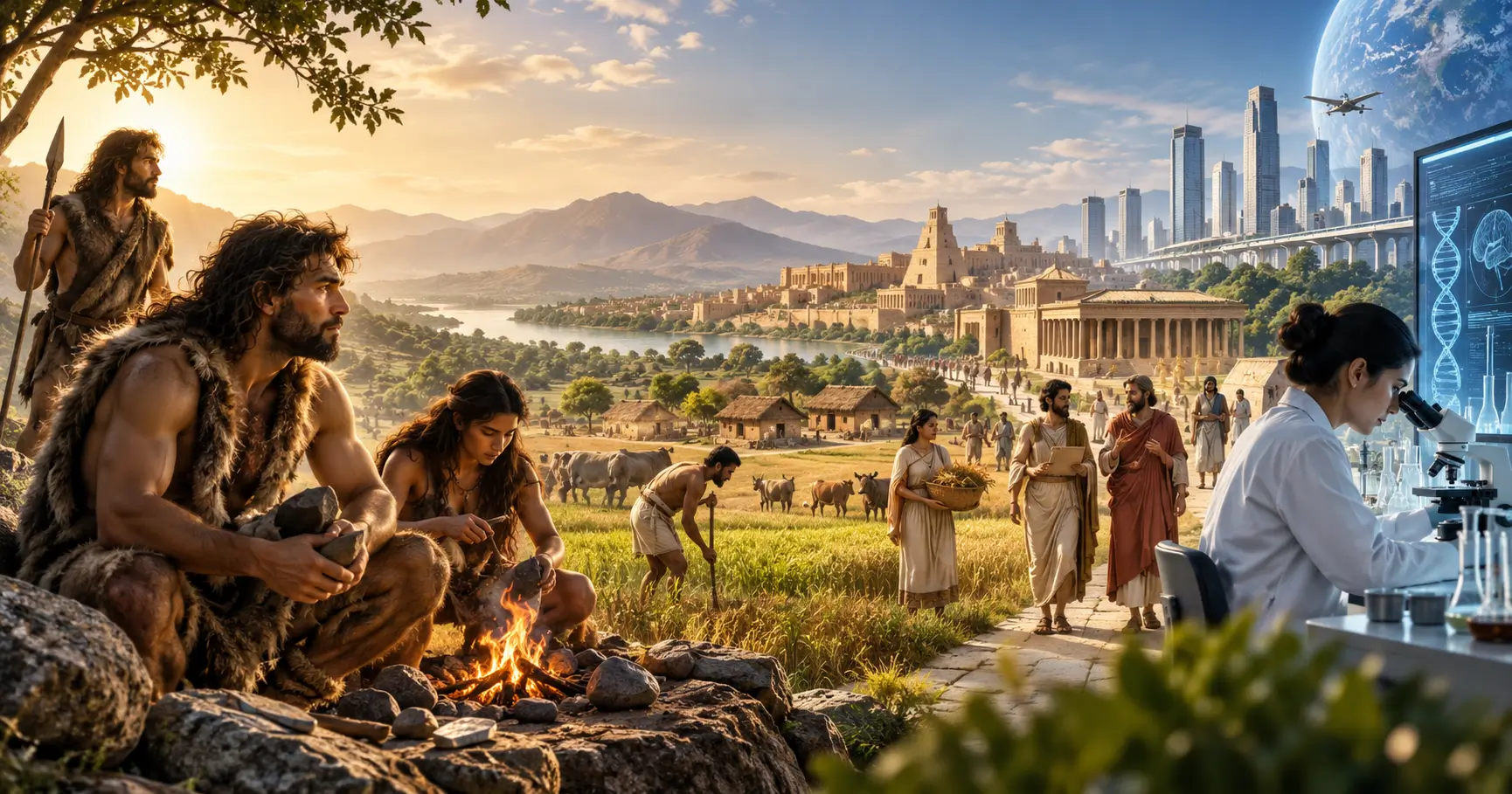
Sapiens: A Brief History of Humankind by Yuval Noah Harari is a sweeping account of how Homo sapiens went from being one relatively ordinary human species to becoming the dominant species on Earth. First published in Hebrew in 2011 and later translated into English, the book combines history, biology, anthropology, economics, and philosophy to examine the forces that transformed human societies.
Harari organizes this enormous story around three major revolutions: the Cognitive Revolution, the Agricultural Revolution, and the Scientific Revolution. He also examines the long process by which money, empires, religions, capitalism, and other shared systems connected increasingly large numbers of people. His central question is not simply how humans became powerful, but why Homo sapiens became capable of cooperating in enormous numbers and creating social systems that do not exist in the physical world.
Sapiens: A Brief History of Humankind Summary
From One Human Species to a Global Civilization
Harari begins by challenging a basic assumption: that humans have always been the obvious rulers of Earth.
For most of human history, Homo sapiens was only one of several human species. Other members of the human genus, including Neanderthals, lived at different times alongside our ancestors. Today, however, only Homo sapiens remains. Harari asks what enabled our species to spread across the planet and ultimately reshape ecosystems, societies, and other species on an extraordinary scale.
His explanation focuses heavily on the ability of humans to cooperate flexibly in very large groups. Harari argues that language was crucial because humans could communicate not only about things they could directly observe, but also about shared concepts, imagined entities, rules, identities, and institutions.
This ability created what Harari calls imagined realities: collectively accepted systems such as gods, nations, laws, money, corporations, and other social institutions. These ideas may not exist as physical objects in nature, but they can have enormous real-world consequences because millions of people organize their behavior around them.
The Cognitive Revolution
Harari places the first great turning point around 70,000 years ago, during what he calls the Cognitive Revolution. The exact causes of this transformation remain uncertain, but Harari argues that something changed in the cognitive and communicative abilities of Homo sapiens.
The important development was not merely that humans could communicate. Other animals communicate as well. What distinguished humans was the extraordinary flexibility of human language and the ability to discuss things that were not physically present.
People could imagine ancestors, spirits, tribes, laws, traditions, distant places, future possibilities, and social rules. This made it possible for large groups of strangers to coordinate their behavior.
Harari presents this as one of the fundamental reasons Homo sapiens became so successful. Human strength was not based simply on individual physical ability. It came from collective organization.
The Power of Shared Beliefs
A small group can cooperate through personal relationships. A much larger society needs something more: common stories and rules.
A nation, for example, can bring together millions of people who will never personally meet. A corporation can coordinate thousands of employees. A legal system can regulate relationships among strangers. Money allows people who do not know one another to exchange goods and services.
According to Harari, these systems work because people collectively accept them.
This idea becomes one of the central themes of Sapiens: human societies are built from both physical reality and shared cultural realities.
Hunter-Gatherers and the Human Past
Before agriculture, most humans lived as hunter-gatherers. Harari challenges the simplistic idea that this period was merely a primitive stage waiting to be replaced by civilization.
Hunter-gatherer communities had their own knowledge, social structures, diets, technologies, and ways of understanding the environment. Humans lived in relatively small communities and depended directly on plants, animals, seasons, landscapes, and ecological knowledge.
Harari also suggests that many of the psychological preferences of modern humans were shaped during this long period because agriculture and civilization are relatively recent developments in evolutionary terms.
This creates an important tension throughout the book: technological and economic progress does not automatically mean that individual human beings became happier or lived easier lives.
The Agricultural Revolution
The next major transformation was the Agricultural Revolution, beginning roughly 12,000 years ago in different regions at different times. Humans increasingly cultivated plants and domesticated animals, settled in permanent communities, and produced food on a larger scale.
At first glance, agriculture appears to be an obvious improvement. It generated larger food supplies and supported growing populations. It eventually contributed to villages, cities, states, writing systems, political institutions, and increasingly complex civilizations.
But Harari turns the conventional story upside down.
Did Agriculture Improve Human Life?
Harari argues that the Agricultural Revolution was not necessarily an improvement for the average individual at first.
Farmers often had to work hard, depend on particular crops, remain tied to specific locations, and face risks from drought, disease, pests, and crop failure. Diets could become less varied than those of some hunter-gatherer groups.
Yet agriculture produced more food per unit of land, allowing human populations to expand dramatically.
This leads to one of the book’s most provocative ideas: a development can be highly successful for a species while making life harder for many individual members of that species.
Wheat, for example, became enormously widespread because humans cultivated it. From this perspective, Harari provocatively asks whether humans domesticated wheat—or whether wheat effectively domesticated humans by encouraging them to settle, farm, and reproduce.
The Growth of Inequality
Permanent settlements created new possibilities for wealth accumulation and social hierarchy.
Once people owned land, stored food, domesticated animals, and accumulated possessions, differences in wealth and power could become more pronounced. Larger societies also required administrators, rulers, soldiers, priests, laborers, and other specialized roles.
Agriculture therefore helped create the foundations of states and civilizations, but it also contributed to inequality and systems of power.
Harari extends this criticism to domesticated animals, arguing that the expansion of agriculture transformed the lives of countless animals, often in ways that benefited human production rather than animal welfare.
Writing, States and the Rise of Complex Societies
As societies grew, human memory was no longer enough to manage increasingly complicated economic and political systems.
This encouraged the development and use of writing and record-keeping.
Writing was not initially created simply to produce literature. Harari emphasizes its importance for practical administration: recording taxes, inventories, transactions, property, laws, and other information.
Large states could therefore organize populations far beyond the scale of earlier communities.
Civilizations developed around systems of administration, religion, military power, law, trade, and social hierarchy.
Harari argues that many of these systems depended on shared assumptions. People could cooperate because they accepted common rules and categories.
The Unification of Humankind
After examining the development of individual societies, Harari turns to a broader historical process: the gradual unification of humankind.
Different communities once lived with very different cultures, languages, religions, political systems, and economic practices. Over centuries, however, certain institutions increasingly connected distant populations.
Harari identifies money, empires, and universal religions as major forces in this process.
Money as a Universal System
Money is powerful because it allows people to cooperate without sharing personal relationships or necessarily sharing the same cultural background.
A person does not have to know the seller personally to trust that money will be accepted in return for goods. This makes trade possible across enormous distances and cultural boundaries.
Harari therefore treats money as more than a financial tool. It is a system of shared trust that allows strangers to cooperate.
The Role of Empires
Empires repeatedly brought different peoples under common political systems.
Although imperial expansion often involved violence, exploitation, and cultural destruction, Harari argues that empires also helped spread languages, laws, technologies, customs, and institutions across large territories.
This produces a complicated historical picture: forces that caused suffering could simultaneously contribute to greater cultural integration.
Universal Religions
Universal religions also crossed political and ethnic boundaries.
Religious systems provided shared moral frameworks and identities that could connect people who belonged to different local communities. Harari examines religions not simply as matters of personal faith, but also as large-scale social systems capable of organizing human cooperation.
The Scientific Revolution
The third major turning point is the Scientific Revolution, which Harari places roughly 500 years ago.
Harari argues that an important feature of modern science was the willingness to acknowledge ignorance.
Earlier societies possessed sophisticated knowledge, but the modern scientific approach increasingly emphasized observation, measurement, mathematics, experimentation, and the possibility that established beliefs could be wrong.
This changed humanity’s relationship with knowledge.
Instead of assuming that important truths were already known, scientists increasingly accepted that major questions remained unanswered.
Science, Exploration and Empire
Scientific knowledge did not develop separately from politics and economics.
European exploration, imperial expansion, military competition, commercial interests, and scientific investigation became closely connected.
Scientific methods improved navigation, mapping, medicine, engineering, military technology, and understanding of the natural world. At the same time, European empires used scientific and technological advantages to expand their influence.
Harari therefore presents science as a powerful force that can produce enormous benefits while also becoming entangled with political power.
Capitalism and the Modern Economy
Another major idea in Sapiens is the rise of capitalism.
Harari explains how modern economies depend heavily on confidence about the future. Banks, investors, entrepreneurs, and consumers operate on expectations that economic activity will generate additional wealth.
Credit allows people and institutions to use resources today based on the expectation of greater wealth tomorrow.
This helped create an economic system capable of enormous expansion.
Harari also connects capitalism with consumerism. Modern economies need people to continue buying products and services, while advertising and cultural expectations can encourage people to see consumption as an important part of life.
The result is a world in which economic growth, technological innovation, consumer demand, and credit reinforce one another.
The Industrial Revolution and Modern Life
The Industrial Revolution dramatically changed human societies by replacing many forms of manual labor with machines and creating new systems of mass production, transportation, communication, and energy use.
Harari examines how industrialization transformed not only economies but also daily life.
People increasingly became part of large-scale systems governed by clocks, schedules, factories, bureaucracies, markets, governments, and modern institutions.
The modern world became more interconnected, productive, and technologically powerful—but also more dependent on complex systems that individuals do not fully control.
Are Modern Humans Happier?
One of the most important questions Harari raises is whether historical progress has actually made humans happier.
Modern people have access to technologies, medicine, transportation, communication, and material goods that would have seemed extraordinary to ancient societies. Yet Harari argues that increased power and material prosperity do not automatically prove increased happiness.
Happiness depends on many factors, including expectations, relationships, social conditions, biology, and subjective experience.
This makes progress difficult to measure. Humanity may have gained enormous power over nature while failing to establish a simple relationship between power and personal well-being.
The Future of Homo Sapiens
The final part of Sapiens looks beyond conventional history.
Harari asks what happens when humans gain the ability to deliberately redesign biological life.
Advances in biotechnology, genetic engineering, and other technologies could eventually allow humans to alter bodies, minds, and biological processes in ways that were previously impossible.
The question therefore changes from “What made humans the way they are?” to “What will humans choose to become?”
Harari suggests that Homo sapiens may eventually move beyond the biological limitations that shaped our species for thousands of generations. He discusses possibilities involving enhanced humans, engineered biological systems, and forms of intelligence that could challenge the traditional definition of humanity.
The book ends not with a simple prediction but with a philosophical challenge: humanity has acquired extraordinary power, but it still needs to decide what it actually wants.
Key Ideas from Sapiens
1. Human cooperation is our greatest strength
Humans can organize enormous numbers of strangers around shared systems, stories, rules, and institutions.
2. Shared beliefs can create real-world power
Money, nations, corporations, laws, and religions depend on collective acceptance, yet their consequences are materially real.
3. Agriculture was not an uncomplicated improvement
The Agricultural Revolution increased food production and population while also bringing harder labor, disease risks, inequality, and dependence on crops and animals.
4. History is not the same as progress
Human societies have become vastly more powerful, but greater power does not automatically produce greater happiness.
5. Science transformed humanity’s relationship with ignorance
Modern science encouraged systematic investigation and the recognition that humans do not possess all the answers.
6. Money connects strangers
A shared monetary system makes cooperation and trade possible across cultural and geographic boundaries.
7. Human power creates ethical responsibility
As biotechnology and other technologies become more powerful, humanity gains the ability to alter its own future—and therefore faces increasingly serious questions about how that power should be used.
Major Themes in Sapiens
- Human evolution
- Cognitive development
- Language and communication
- Shared beliefs and imagined realities
- Hunter-gatherer societies
- Agricultural Revolution
- Domestication
- Inequality
- Religion
- Empires
- Money
- Capitalism
- Scientific Revolution
- Industrialization
- Consumerism
- Human happiness
- Technology
- Biotechnology
- Future of humanity
Overall Message of Sapiens
The central message of Sapiens: A Brief History of Humankind is that human dominance is not simply the result of superior physical strength or intelligence. Harari emphasizes the extraordinary capacity of Homo sapiens to cooperate flexibly on a massive scale through shared ideas and institutions.
The book also challenges the assumption that every major historical transformation automatically improved human life. Agriculture, empire, capitalism, industrialization, and scientific progress produced immense power and complexity, but they also created new forms of inequality, dependence, suffering, and risk.
Ultimately, Sapiens asks readers to look at humanity from a distance. Instead of treating modern institutions as natural or inevitable, Harari encourages us to examine how they developed and why people continue to believe in them.
The book’s final question is therefore about the future as much as the past: if humans are becoming capable of redesigning life itself, what kind of future should they create?
FAQs About Sapiens: A Brief History of Humankind
Who wrote Sapiens: A Brief History of Humankind?
Sapiens: A Brief History of Humankind was written by Israeli historian Yuval Noah Harari. The book was first published in Hebrew in 2011, with the English edition following in 2014.
What is Sapiens mainly about?
The book explains the development of Homo sapiens from early human societies to the modern world. It focuses particularly on the Cognitive Revolution, Agricultural Revolution, Scientific Revolution, and the social systems that enabled large-scale human cooperation.
What are the three major revolutions in Sapiens?
Harari primarily structures the book around the Cognitive Revolution, the Agricultural Revolution, and the Scientific Revolution. The Cognitive Revolution transformed human communication and cooperation; agriculture created settled societies and larger populations; and modern science transformed humanity’s ability to investigate and control the natural world.
What does Harari mean by an imagined reality?
An imagined reality is a collectively accepted concept or institution that does not exist as a physical object in the same way that a tree or mountain does, but nevertheless strongly influences human behavior. Examples discussed in the book include money, nations, laws, religions, and corporations.
Why is the Agricultural Revolution important in Sapiens?
It changed humans from predominantly mobile hunter-gatherer communities into increasingly settled agricultural societies. Agriculture supported much larger populations and eventually helped produce cities and states, but Harari also emphasizes its costs, including increased labor, inequality, disease, and dependence on domesticated species.
What does Sapiens say about money?
Harari presents money as one of humanity’s most successful systems of shared trust. Because people collectively believe that money has value and will be accepted by others, it allows strangers from different cultures and regions to cooperate economically.
Does Sapiens argue that modern humans are happier?
Harari questions whether greater technological and material power necessarily produces greater happiness. He argues that happiness is complex and that historical progress does not provide a simple guarantee of increased individual well-being.
What is the main lesson of Sapiens?
One major lesson is that humanity’s extraordinary success comes from its ability to create shared ideas and coordinate large groups around them. The book also encourages readers to question whether technological and economic progress should automatically be considered human progress.
Disclaimer
This article is an original educational summary of Sapiens: A Brief History of Humankind by Yuval Noah Harari. It is intended to explain the book’s major ideas, arguments, themes, and historical framework in simplified language. It is not a substitute for reading the original book and does not reproduce its text. Historical interpretations presented in the book can be debated, and readers should consult the original work and scholarly sources for deeper study. All rights to the original book remain with its author and publisher.
One Comment