
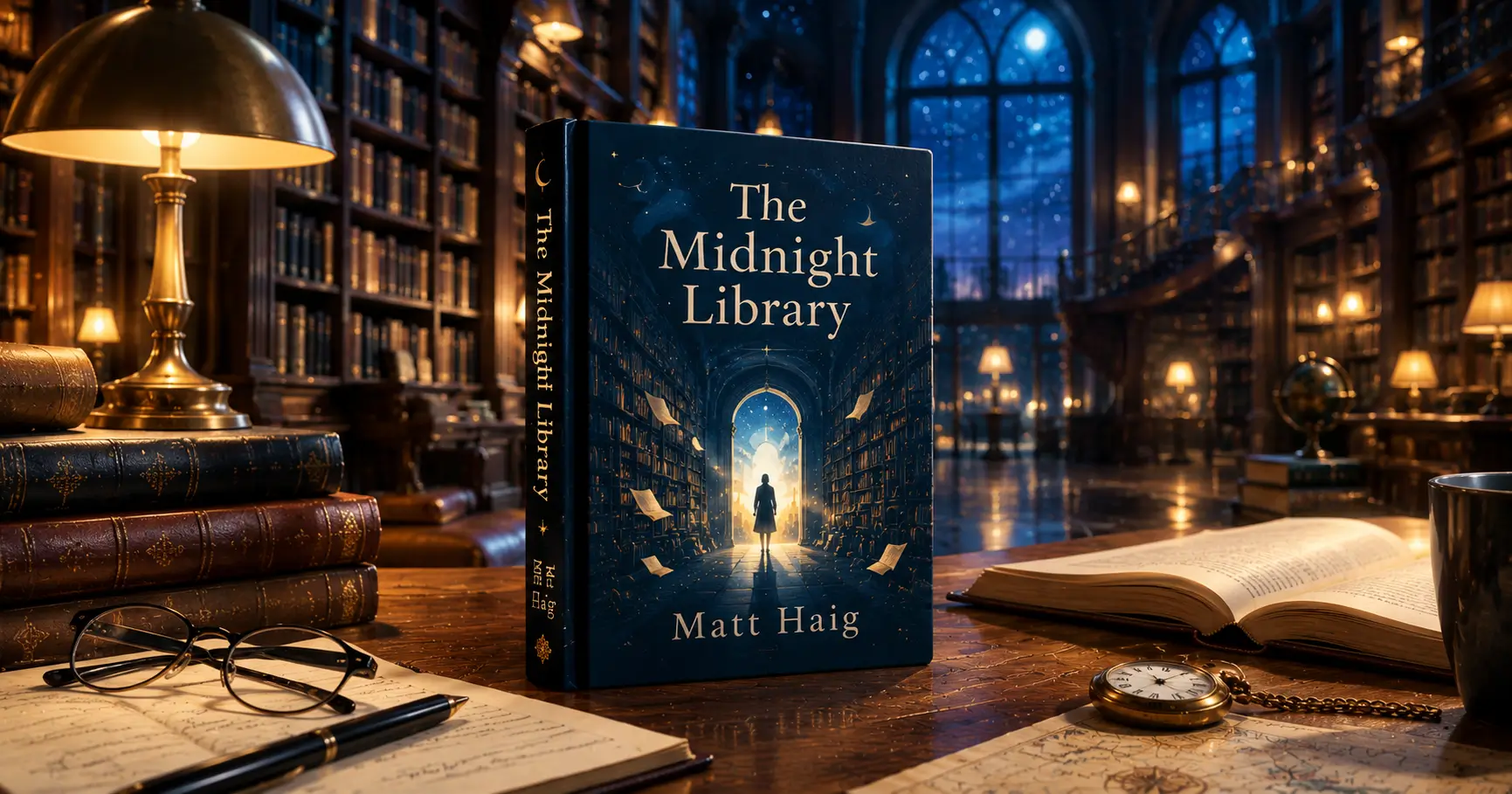
The Midnight Library PDF Download – Matt Haig Book
Book Short Summaries with Lessons
Introduction
The Midnight Library by Matt Haig follows Nora Seed, a woman who becomes overwhelmed by regret and believes that her life has failed to become what it could have been. At a mysterious library between life and death, Nora discovers that each book represents a different life she might have lived if she had made different choices.
The novel asks a powerful question: If you could experience every life you might have lived, would you finally find the perfect one? The story ultimately argues that a meaningful life is not necessarily a perfect life.
Opening Chapters: Nora’s Life Before the Library
A Conversation About Rain — Young Nora meets Mrs Elm, whose encouragement introduces the idea that life contains many possible futures.
Nineteen Years Later — Nora is now an isolated adult struggling with disappointment, regret, and a growing sense that her possibilities have disappeared.
The Man at the Door — Doctor Ash arrives with news that Nora’s cat, Voltaire, has died, deepening her despair.
String Theory — Nora loses her job at the music shop and reflects on abandoned ambitions involving swimming, music, relationships, and philosophy.
To Live Is to Suffer — Nora’s thoughts become increasingly focused on failure and the belief that suffering makes life unbearable.
Doors — She thinks about the many directions her life could have taken and the doors she believes she closed.
How to Be a Black Hole — Nora feels empty and disconnected, imagining herself as something that absorbs rather than creates meaning.
Antimatter — Her final remaining connections begin disappearing, leaving her feeling completely alone.
00:00:00 — At midnight, Nora enters the mysterious space between life and death and finds herself in the Midnight Library.
Lesson: A person’s worst moment can make the future appear smaller than it really is.
The Midnight Library and the Book of Regrets
The Librarian — Nora discovers that the librarian is Mrs Elm, a familiar figure from her childhood.
The Midnight Library — Mrs Elm explains that the library contains books representing different possible versions of Nora’s life.
The Moving Shelves — The endless shelves symbolize the enormous number of possibilities created by different decisions.
The Book of Regrets — Nora sees a special book containing the regrets she has accumulated throughout her life.
Regret Overload — The sheer weight of those regrets overwhelms Nora and forces her to confront how heavily she judges herself.
Every Life Begins Now — Mrs Elm explains that Nora can enter alternative lives and experience the consequences of different choices.
The Three Horseshoes — Nora first chooses the life in which she married Dan and helped run the pub they once imagined owning.
The Penultimate Update Nora Had Posted Before She Found Herself Between Life and Death — A glimpse of Nora’s old despair emphasizes how trapped she felt before entering the library.
The Chessboard — Mrs Elm uses chess and choice to help Nora understand that life cannot be reduced to perfect decisions.
The Only Way to Learn Is to Live — Nora discovers that even a seemingly better decision can produce an unexpected result.
Lesson: Regret often comes from imagining an alternative without imagining all of its consequences.
Australia and the Olympic Life
Fire — Nora enters the life where she moved to Australia with Izzy but discovers that Izzy died in an accident.
Fish Tank — Nora reflects on depression and questions whether changing external circumstances alone can solve internal suffering.
The Last Update That Nora Had Posted Before She Found Herself Between Life and Death — Another fragment of her original life shows how deeply exhausted she had become.
The Successful Life — Nora becomes an Olympic swimming champion but discovers that fame, achievement, and physical success have not removed her unhappiness.
Peppermint Tea — She learns more about her brother Joe and realizes that her successful life has also involved painful family consequences.
The Tree That Is Our Life — Nora gives an improvised speech about the branching nature of life and begins questioning society’s narrow definition of success.
System Error — The library begins malfunctioning because Nora’s original life is approaching a critical point, creating urgency.
Lesson: Achievement can change circumstances, but it cannot automatically create purpose, connection, or peace.
Svalbard and the Desire to Live
Svalbard — Nora enters a life as a glaciologist working in the Arctic, finally experiencing a dream she once abandoned.
Hugo Lefèvre — She meets Hugo, another person connected to the library’s strange possibilities.
Walking in Circles — Nora is left alone as a polar-bear spotter and experiences a powerful form of solitude surrounded by nature.
A Moment of Extreme Crisis in the Middle of Nowhere — A polar bear approaches, placing Nora in immediate danger.
The Frustration of Not Finding a Library When You Really Need One — Nora desperately tries to escape but discovers something important: she genuinely wants to survive.
Island — After the danger passes, Nora recognizes that the experience has awakened a desire to remain alive.
Permafrost — The Arctic experience makes her reconsider whether expectations of achievement have caused some of her dissatisfaction.
One Night in Longyearbyen — Hugo discusses the many-worlds interpretation of quantum mechanics, reinforcing the novel’s idea of multiple possible realities.
Expectation — Nora thinks about the gap between what people expect life to be and what life actually becomes.
Life and Death and the Quantum Wave Function — The novel connects scientific ideas about possibility with Nora’s personal struggle to choose a life.
If Something Is Happening to Me, I Want to Be There — Nora’s connection with Hugo does not become the answer she expected, so she leaves that life.
Lesson: Sometimes the strongest evidence that life matters is the sudden realization that you do not want to lose it.
Fame, Music and the Cost of Success
God and Other Librarians — Mrs Elm explains that Nora’s regrets are becoming lighter as her perspective changes.
Fame — Nora enters a life where The Labyrinths became hugely successful and she performs before a massive audience.
Milky Way — The energy of the crowd gives Nora a powerful sense of connection.
Wild and Free — Fame initially feels liberating, but Nora discovers that celebrity brings pressure and complications.
Ryan Bailey — Nora learns that even her relationship with a famous actor has not created the happiness she expected.
A Silver Tray of Honey Cakes — The glamorous life reveals loneliness, media pressure, and the consequences of celebrity.
The Podcast of Revelations — During an interview, Nora discovers uncomfortable truths about this version of herself.
‘Howl’ — The band’s music becomes another reminder that success can carry emotional costs.
Love and Pain — Learning that Joe died in this reality deeply affects Nora and makes her question the value of pursuing someone else’s dream.
Lesson: Fame and recognition are not reliable measures of a fulfilling life.
Learning to Choose for Herself
Equidistance — Nora remembers being caught in a river as a child, a memory that reflects her lifelong difficulty committing to one direction.
Someone Else’s Dream — She realizes many of her ambitions were influenced by what other people wanted for her.
A Gentle Life — Nora tries a quieter life working with animals and discovers genuine satisfaction in kindness and care.
Why Want Another Universe If This One Has Dogs? — Dylan shows Nora that a person can appreciate an ordinary life without constantly comparing it with alternatives.
Dinner with Dylan — Nora sees that Dylan is kind but understands that simplicity alone is not necessarily the answer for her.
Last Chance Saloon — Nora begins realizing that no alternate life can permanently remove her inner uncertainty.
Buena Vista Vineyard — She experiences a comfortable life running a vineyard but again discovers that comfort does not automatically create fulfillment.
The Many Lives of Nora Seed — After experiencing many possibilities, Nora recognizes that constantly searching for a perfect life has become another form of dissatisfaction.
Lesson: Your ideal life cannot simply be borrowed from someone else’s definition of happiness.
The Life That Seems Perfect
Lost in the Library — Nora becomes increasingly disoriented as the endless possibilities begin to overwhelm her.
A Pearl in the Shell — She enters a life with Ash and discovers that she has a daughter named Molly.
The Game — A conversation with Molly helps Nora understand the details of this family life.
The Perfect Life — Nora finds herself living as a philosophy professor with Ash, Molly, her brother Joe, and a stable family life.
A Spiritual Quest for a Deeper Connection with the Universe — She enjoys studying Thoreau and realizes that this life contains many things she once wanted.
Hammersmith — Nora spends time with Joe and discovers that her brother is happy and healthy in this reality.
Tricycle — A small accident involving Molly reminds Nora how deeply she cares about the people in this life.
No Longer Here — Nora discovers that Mrs Elm has died in this reality, showing her that even apparently perfect lives contain loss.
An Incident With the Police — Nora sees that her influence on other people mattered in ways she never understood in her original life.
A New Way of Seeing — She begins seeing her old hometown differently and realizes that her perspective had shaped her sense of imprisonment.
The Flowers Have Water — Nora says goodbye to Ash and Molly as she understands that she cannot remain in this borrowed version of her life.
Lesson: A meaningful life is built through relationships and choices, not through a checklist of perfect achievements.
The Final Choice
Nowhere to Land — Nora returns to the library as it begins to break apart because her original life is reaching a decisive point.
Don’t You Dare Give Up, Nora Seed! — Mrs Elm encourages Nora to fight for the life she came from rather than searching for another escape.
Awakening — Nora returns to her original reality with a renewed desire to live.
The Other Side of Despair — She begins to understand that despair had prevented her from seeing possibilities that were still available.
A Thing I Have Learned — Nora recognizes that her greatest problem was not the existence of other lives but her obsession with regretting the one she had.
Living Versus Understanding — She reconnects with Joe and begins to understand that life does not have to be completely understood before it can be lived.
The Volcano — Nora sees herself differently, recognizing that she can grow and create rather than merely absorb disappointment.
How It Ends — Nora meets the real Mrs Elm again and plays chess with her, symbolizing that life remains uncertain and that the next move is still hers.
Final Lesson: You do not need to discover the perfect life. You need to participate in the life you have and remain open to what it can become.
Main Points and Lessons From The Midnight Library
1. Regret can distort the past.
We often imagine that an alternative decision would automatically have produced a better life. Nora learns that every choice has consequences that cannot be predicted completely.
2. There is no perfect life.
Even Nora’s most attractive alternative lives contain disappointment, loss, loneliness, or uncertainty.
3. Success is personal.
Being an Olympic champion or international celebrity does not necessarily make Nora happier.
4. Small actions matter.
Nora discovers that seemingly ordinary relationships and acts of kindness can affect other people’s lives.
5. Other people’s expectations can become our regrets.
Some of Nora’s ambitions were shaped by her family, friends, or society rather than by her deepest desires.
6. The future is not the same as the past.
The fact that Nora made mistakes does not mean that every future decision is already determined.
7. Connection gives life meaning.
Family, friendship, kindness, animals, nature, and genuine human relationships become more important to Nora than status.
8. A meaningful life can be imperfect.
The novel’s final message is not that problems disappear. Instead, Nora learns that an imperfect life can still contain enormous possibility.
9. Choice requires action.
Nora cannot simply think her way into a better existence. She must eventually make choices and live with uncertainty.
10. Hope begins when possibility becomes visible.
The Midnight Library gives Nora a way to see that her story is not finished. Once she understands this, she can return to her own life with a different perspective.
Book Information
| Information | Details |
|---|---|
| Book Title | The Midnight Library |
| Author | Matt Haig |
| Published | August 2020 |
| Genre | Fiction / Speculative Fiction |
| Pages | 304 pages — Penguin India paperback edition |
| Language | English |
The publisher lists the Penguin India edition at 304 pages and identifies the book as published in August 2020; Canongate lists the original UK publication as 13 August 2020. Page counts vary by edition and format.
About the Author
Matt Haig is an internationally bestselling British author known for novels including The Midnight Library, The Humans, How to Stop Time, and The Life Impossible. He has also written the nonfiction works Reasons to Stay Alive and The Comfort Book. His writing frequently explores mental health, identity, time, hope, human connection, and the meaning people find in ordinary life. His work has been translated into more than fifty languages.
FAQ
Is The Midnight Library available as a PDF?
Digital editions of The Midnight Library are commercially available, but a legitimate free PDF of the complete copyrighted book was not identified through the official publisher and author sources reviewed.
Where can I legally get The Midnight Library PDF?
The safest option is to use an authorized ebook retailer or the official publisher’s distribution channels. The Penguin Random House India book page provides verified edition information and purchasing options.
Who wrote The Midnight Library?
The Midnight Library was written by Matt Haig and was first published in August 2020. Canongate lists the original UK publication date as 13 August 2020.
What is The Midnight Library about?
The novel follows Nora Seed, who enters a mysterious library between life and death where she can experience alternative versions of her life based on different choices.
What is the main lesson of The Midnight Library?
The central lesson is that there is no perfect life. Nora learns that regret can distort how people imagine alternative choices and that an imperfect present can still contain meaningful possibilities.
How many pages is The Midnight Library?
The Penguin Random House India paperback edition is listed at 304 pages. Other editions have different page counts, so the exact length depends on the edition and format.
Disclaimer
This page contains original editorial content created to explain and summarize The Midnight Library by Matt Haig. The summary is not a reproduction of the book and does not replace the original work.
Book editions can have different publication dates, page counts, formats, ISBNs, and cover designs. Readers should verify edition information with the publisher or an authorized bookseller before purchasing or accessing a digital edition.
Any download or purchase option should be obtained through an authorized source. PDFToday.in does not encourage copyright infringement or unauthorized distribution of copyrighted books.