
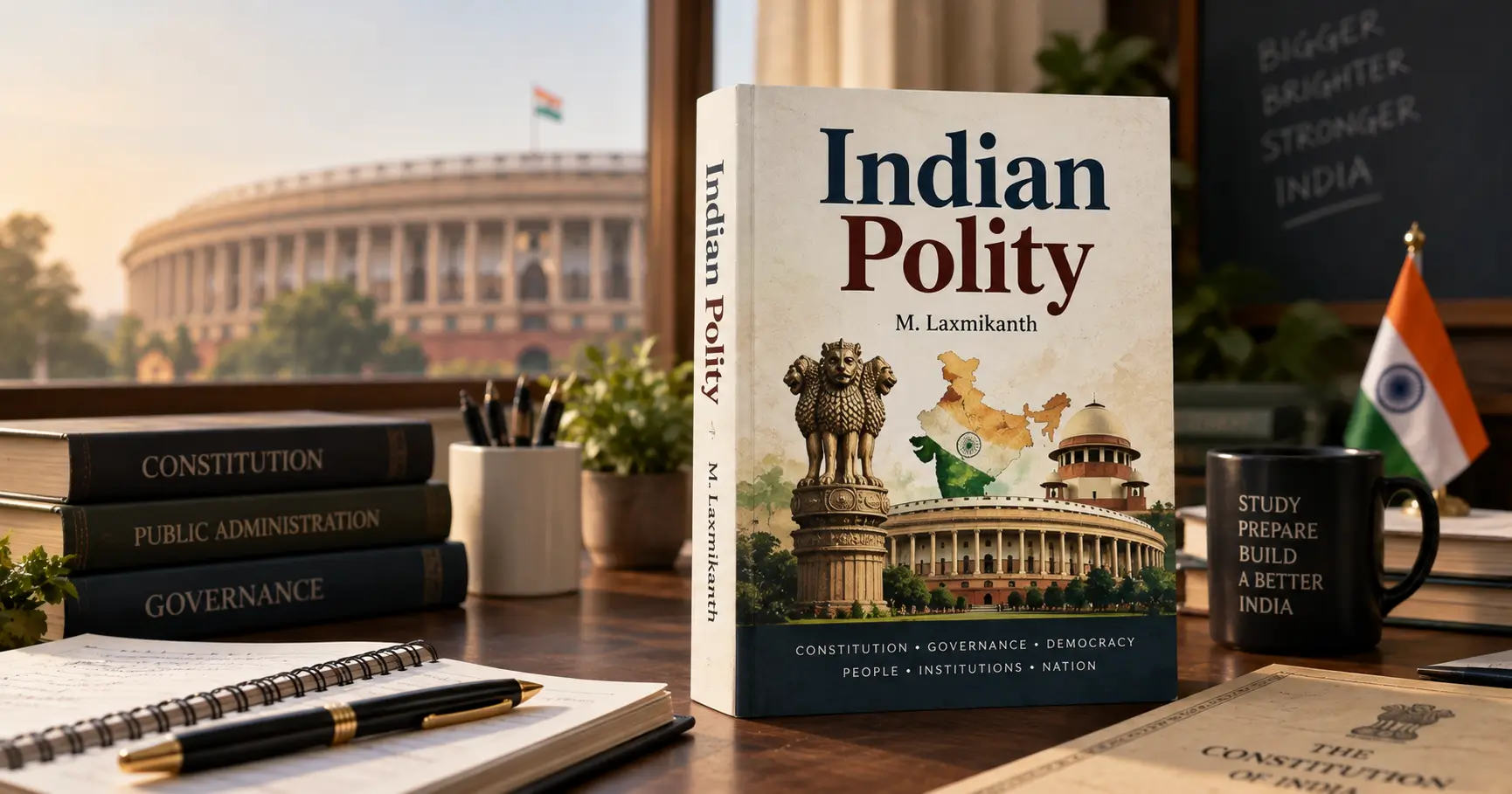
Indian Polity by M. Laxmikanth PDF Download: Summary & Lessons
Indian Polity by M. Laxmikanth: Chapter Summaries and Lessons
Indian Polity by M. Laxmikanth is a comprehensive study of India’s Constitution, political institutions, governance system and democratic processes. The current 8th edition is published by McGraw Hill and contains 92 structured chapters, along with appendices, conceptual videos and examination-oriented question resources.
Constitutional Foundations
1. Historical Background — Explains constitutional developments under British rule.
Lesson: India’s constitutional system has deep historical roots.
2. Making of the Constitution — Covers the Constituent Assembly and constitution-making process.
Lesson: India’s Constitution emerged through extensive deliberation.
3. Concept of Constitution — Explains the meaning and purpose of constitutions.
Lesson: Constitutions establish the framework of government.
4. Salient Features of the Constitution — Describes India’s distinctive constitutional characteristics.
Lesson: India combines federal and unitary features.
5. Preamble of the Constitution — Explains the Constitution’s guiding ideals.
Lesson: Justice, liberty, equality and fraternity shape its vision.
6. Union and Its Territory — Covers India’s territory and state reorganization.
Lesson: Territorial arrangements operate through constitutional authority.
7. Citizenship — Explains constitutional citizenship provisions.
Lesson: Citizenship defines membership in the Indian political community.
8. Fundamental Rights — Examines constitutionally protected individual rights.
Lesson: Rights provide safeguards against unconstitutional state action.
9. Directive Principles of State Policy — Discusses principles guiding welfare-oriented governance.
Lesson: Governance also pursues social and economic justice.
10. Fundamental Duties — Explains constitutional duties of citizens.
Lesson: Democratic citizenship involves responsibilities as well as rights.
11. Amendment of the Constitution — Explains constitutional amendment procedures.
Lesson: The Constitution can adapt to changing circumstances.
12. Basic Structure of the Constitution — Explains limits on constitutional amendments.
Lesson: Parliament cannot destroy the Constitution’s basic structure.
Parliamentary and Federal Government
13. Parliamentary System — Explains India’s parliamentary model.
Lesson: The executive is accountable to the legislature.
14. Federal System — Examines India’s federal structure.
Lesson: Powers are divided between Union and states.
15. Centre–State Relations — Covers legislative, administrative and financial relations.
Lesson: Federal governance requires coordination.
16. Inter-State Relations — Explains cooperation and disputes among states.
Lesson: Inter-state coordination supports national unity.
17. Emergency Provisions — Examines constitutional emergency mechanisms.
Lesson: Extraordinary powers operate within constitutional limits.
Union and State Institutions
18–25. President to Parliament — These chapters explain the President, Vice-President, Prime Minister, Council of Ministers, Cabinet Committees, Parliament, Parliamentary Committees and Parliamentary Group.
Lesson: India’s parliamentary executive and legislature operate through defined constitutional roles and accountability mechanisms.
26–29. Supreme Court and Judicial Processes — Covers the Supreme Court, judicial review, judicial activism and public interest litigation.
Lesson: An independent judiciary helps interpret and protect the Constitution.
30–38. State Government and Courts — Covers Governor, Chief Minister, State Council of Ministers, State Legislature, High Courts, subordinate courts, tribunals, consumer dispute institutions and Lok Adalats.
Lesson: Constitutional government extends from the Union to state and judicial institutions.
Local Government and Constitutional Bodies
39–42. Panchayats, Municipalities and Special Areas — Explains local self-government, Union Territories and scheduled and tribal areas.
Lesson: Democratic governance also depends on decentralization and regional arrangements.
43–55. Constitutional Bodies — Examines the Election Commission, UPSC, State Public Service Commissions, Finance Commission, GST Council, commissions for disadvantaged communities, CAG, Attorney General and Advocate General.
Lesson: Independent constitutional institutions provide accountability and specialized functions.
Statutory and Other Institutions
56–72. Important Institutions — Covers NITI Aayog, human-rights commissions, commissions for women, children and minorities, information commissions, vigilance bodies, CBI, Lokpal, NIA, disaster management, Bar Council, Law Commission, Delimitation Commission and cooperative societies.
Lesson: India’s governance system relies on many specialized institutions beyond the three traditional organs of government.
73–77. Language, Public Services and Special Provisions — Explains official language, public services, government liabilities and special constitutional provisions.
Lesson: Constitutional governance accommodates administrative, linguistic and regional diversity.
Political Process and Democracy
78. Political Parties — Explains the role of political parties.
Lesson: Parties connect citizens with representative government.
79. Role of Regional Parties — Examines regional political forces.
Lesson: Regional diversity strongly influences Indian politics.
80. Elections — Explains India’s electoral process.
Lesson: Elections are central to representative democracy.
81. Election Laws — Examines the legal framework governing elections.
Lesson: Electoral processes require enforceable rules.
82. Electoral Reforms — Discusses efforts to improve elections.
Lesson: Democratic institutions require continuous improvement.
83. Voting Behaviour — Examines factors influencing voters.
Lesson: Indian voting patterns reflect complex social and political factors.
84. Coalition Government — Explains multi-party governments.
Lesson: Coalition politics requires negotiation and coordination.
85. Anti-Defection Law — Examines rules concerning legislative defections.
Lesson: Political stability must be balanced with legislative independence.
86. Pressure Groups — Explains organized influence on public policy.
Lesson: Political participation extends beyond elections.
87. National Integration — Examines challenges to national unity.
Lesson: Constitutional democracy must accommodate India’s diversity.
88. Foreign Policy — Introduces India’s external-policy framework.
Lesson: Domestic governance operates within a wider international environment.
89. National Commission to Review the Working of the Constitution — Examines constitutional review.
Lesson: Constitutional systems can be evaluated and improved.
90. Landmark Judgements and Their Impact — Reviews important judicial developments.
Lesson: Court decisions have shaped constitutional governance.
91. Important Doctrines of Constitutional Interpretation — Explains principles used in constitutional interpretation.
Lesson: Judicial interpretation influences how constitutional provisions operate.
92. World Constitutions — Provides comparative constitutional perspectives.
Lesson: Comparing constitutional systems helps explain India’s distinctive model.
Main Points and Lessons
The central lesson of Indian Polity is that India’s Constitution works as an interconnected system. Fundamental Rights, Parliament, executive government, judiciary, federalism, elections, constitutional bodies and local government cannot be fully understood in isolation.
For students, the book provides a structured way to understand constitutional provisions, institutional powers, accountability, democratic representation and Centre–State relations. McGraw Hill describes the current edition as covering India’s political and constitutional framework and supporting Civil Services and State Services preparation.
The book is therefore useful not only for memorizing constitutional provisions but also for understanding how India’s democratic institutions interact with one another.
Book Information
| Information | Details |
|---|---|
| Book Title | Indian Polity / Courseware on Indian Polity |
| Author | M. Laxmikanth |
| Published | 8th Edition, 2025 |
| Genre | Indian Polity / Civil Services Exam Preparation |
| Pages | 848 pages* |
| Language | English |
McGraw Hill confirms the 8th edition, ISBN 9789364447676, author and publication date of July 28, 2025. Current retail listings for the same ISBN report 848 pages, although some catalogues list different pagination; therefore page count can vary by catalogue record.
About the Author
M. Laxmikanth is an Indian political science author and educator best known for Indian Polity. He holds a degree in Political Science from Osmania University and has experience teaching civil-service aspirants through his IAS coaching academy. His other works include Governance in India, Objective Indian Polity and Public Administration. His teaching experience strongly informs the examination-oriented and structured approach of Indian Polity.
FAQ
What is Indian Polity by M. Laxmikanth about?
It explains India’s Constitution, government institutions, federalism, judiciary, elections, constitutional bodies and democratic political processes.
Who wrote Indian Polity?
Indian Polity was written by M. Laxmikanth.
Is Indian Polity by M. Laxmikanth available as a PDF?
The current 8th edition has an authorized digital-courseware option from McGraw Hill that includes access to a full-colour eBook. The publisher does not identify a free public PDF download on its official page.
Where can I download Indian Polity PDF legally?
For the current edition, readers should use McGraw Hill’s official product and digital-courseware page rather than unauthorized PDF websites.
Is a free PDF of Indian Polity available?
A verified free authorized PDF of the current edition was not identified. The official publisher provides purchasing and authorized digital-courseware options.
What are the main lessons of Indian Polity?
The book explains constitutional government, Fundamental Rights, Parliament, judiciary, federalism, elections, constitutional bodies and the interaction between India’s major democratic institutions.
Is Indian Polity useful for UPSC?
Yes. McGraw Hill specifically describes the book as an important resource for Civil Services and State Services aspirants.
How many chapters are in the 8th edition?
McGraw Hill’s official listing identifies 92 structured chapters in the 8th edition.
Disclaimer
This page contains an original summary of Indian Polity by M. Laxmikanth and does not reproduce the book’s text. It is intended for educational purposes and should not replace the original book. PDFToday.in does not support copyright infringement. Readers should obtain copyrighted books through official publishers, authorized sellers, libraries or legitimate digital platforms.