
Indian Polity by M. Laxmikanth: Complete Book Summary
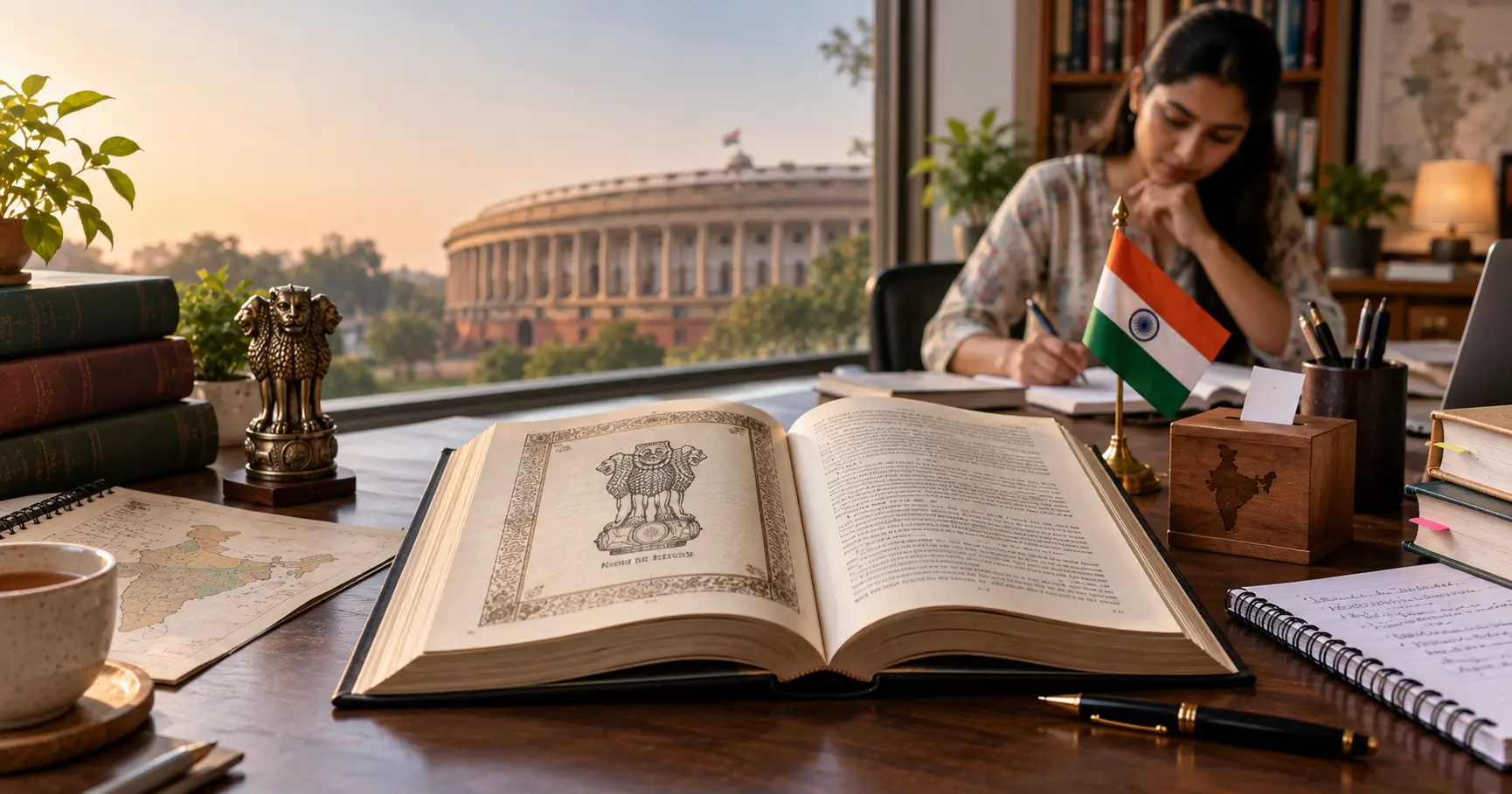
Indian Polity by M. Laxmikanth is a comprehensive guide to the Indian Constitution, political system, government institutions, and processes of governance. The book explains how India’s constitutional framework was created, how the Union and state governments function, how Parliament and the judiciary operate, and how constitutional principles shape Indian democracy. It is particularly important for UPSC and State Civil Services preparation, but its systematic treatment also makes it useful for readers who want to understand Indian government and constitutional institutions.
McGraw Hill currently lists an 8th edition of Indian Polity by M. Laxmikanth, with the book continuing to cover India’s political and constitutional framework in a structured manner.
The Constitutional Foundation of India
The book begins by establishing the historical and constitutional foundations of modern India. Understanding the present political system requires understanding the developments that took place during British rule. The early constitutional and administrative measures introduced by the British gradually changed the structure of governance and eventually contributed to the development of institutions that influenced independent India.
The making of the Constitution is another major starting point. The Constituent Assembly was responsible for preparing the Constitution, debating its provisions, examining different models of government, and creating a framework suited to India’s social and political conditions. The book discusses the composition and functioning of the Assembly, its important committees, the drafting process, and the eventual adoption and enforcement of the Constitution. The Constitution came into force on 26 January 1950.
A major theme is that the Indian Constitution combines several ideas and institutional features while adapting them to Indian circumstances. It establishes a democratic republic with a parliamentary system, a federal structure with a strong Union, an independent judiciary, fundamental rights, directive principles, and constitutional mechanisms for maintaining democratic government.
The Preamble provides the broad philosophical direction of the Constitution. It describes India as a sovereign, socialist, secular, democratic republic and emphasizes justice, liberty, equality, and fraternity. The book treats the Preamble as an important guide for understanding the objectives and character of the constitutional system.
The Constitution also establishes the territory of India and provides mechanisms through which Parliament can reorganize states and alter their boundaries. Citizenship is addressed both through constitutional provisions and legislation, reflecting India’s system of single citizenship.
Fundamental Rights, Directive Principles and Duties
One of the most important sections of Indian Polity deals with the relationship between citizens and the State.
Fundamental Rights protect essential freedoms and establish constitutional safeguards against arbitrary state action. These include the Right to Equality, Right to Freedom, Right Against Exploitation, Right to Freedom of Religion, Cultural and Educational Rights, and the Right to Constitutional Remedies.
The Right to Constitutional Remedies is particularly important because it enables individuals to approach the courts for protection of their fundamental rights. The constitutional writs—such as habeas corpus, mandamus, prohibition, certiorari, and quo warranto—form an important part of India’s system of judicial protection.
The book also explains that Fundamental Rights are not completely unlimited. The Constitution permits reasonable restrictions in certain circumstances, creating a balance between individual liberty and legitimate public interests.
Alongside Fundamental Rights are the Directive Principles of State Policy. These principles provide broad directions for governments to promote social and economic welfare and establish conditions associated with a just society. Unlike Fundamental Rights, they are not generally enforceable by courts, but they are fundamental to the governance of the country.
The Fundamental Duties add another dimension to constitutional citizenship. They describe responsibilities expected from citizens, including respect for the Constitution, national symbols, public property, the environment, and the values of harmony and scientific inquiry.
The book therefore presents the constitutional framework as a balance between rights, responsibilities and social objectives.
Parliamentary and Federal System of Government
A central idea in Indian Polity is how India’s system of government distributes political authority.
India follows a parliamentary system in which the President is the constitutional head of the Union, while the Prime Minister and Council of Ministers exercise the principal executive authority within the parliamentary framework. The Council of Ministers is collectively responsible to the Lok Sabha.
The book explains the constitutional position, powers and functions of the President, Vice-President, Prime Minister and Council of Ministers. It also examines Parliament, consisting of the President, Rajya Sabha and Lok Sabha.
Parliament performs several important functions. It makes laws, exercises financial control, debates public issues, represents citizens and scrutinizes the work of the executive. Parliamentary committees further assist in examining legislation, expenditure and administrative functioning.
The federal system is another major theme. India divides legislative, administrative and financial responsibilities between the Union and the states. However, the Constitution gives the Union substantial powers, especially in areas involving national unity, emergencies and certain aspects of administration.
Centre–State relations therefore receive considerable attention. These relations involve legislative, administrative and financial dimensions. The Constitution also provides mechanisms for dealing with disputes and promoting coordination between different levels of government.
Emergency provisions illustrate the strong role of the Union in exceptional circumstances. The Constitution provides separate mechanisms dealing with national emergency, constitutional breakdown in a state and financial emergency.
President, Judiciary and Constitutional Institutions
The Indian political system depends on several institutions that act as checks, safeguards and mechanisms of accountability.
The Supreme Court stands at the top of India’s judicial system. The book explains judicial review, constitutional interpretation, writ jurisdiction, judicial independence and the relationship between Parliament and the judiciary. The judiciary plays an important role in protecting constitutional principles and fundamental rights.
The concept of the Basic Structure Doctrine is particularly significant. The doctrine emerged from Supreme Court decisions concerning Parliament’s power to amend the Constitution. It establishes that Parliament’s amending power is broad but cannot be used to destroy the basic structure of the Constitution.
The book also examines institutions such as the Election Commission, Union Public Service Commission, Finance Commission, Comptroller and Auditor General, and other constitutional and statutory bodies. These institutions perform specialized functions that support elections, public recruitment, financial accountability and constitutional governance.
The Election Commission is especially important to India’s democratic system because elections provide the principal mechanism through which citizens choose their representatives. The book connects elections with political parties, electoral laws, voting behaviour, electoral reforms and the broader functioning of representative democracy.
State Government and Local Government
Indian democracy does not operate only at the Union level. State governments form another major part of the constitutional system.
The book explains the roles of the Governor, Chief Minister, Council of Ministers, State Legislature and High Courts. Although the basic parliamentary model exists at both Union and state levels, the constitutional powers and institutional relationships at the state level have their own characteristics.
Local government is another important component. The 73rd and 74th Constitutional Amendments strengthened the constitutional position of rural and urban local bodies. Panchayats and municipalities provide institutional mechanisms for local participation and decentralized governance.
The broader principle behind local government is that democratic administration should not remain concentrated at higher levels. Local institutions can address community-level needs and provide citizens with opportunities to participate more directly in governance.
Elections, Political Parties and Democratic Processes
The book moves beyond constitutional institutions to examine the political processes through which the system actually operates.
Political parties are essential to parliamentary democracy because they organize political participation, nominate candidates, develop policy positions and help form governments. Regional parties also have an important role, particularly in India’s diverse federal political environment.
The anti-defection law addresses changes in political allegiance by legislators and seeks to discourage certain forms of political instability caused by defections. At the same time, the book examines wider questions involving coalition governments, pressure groups, electoral reforms, voting behaviour and national integration.
This part of the book demonstrates that understanding Indian polity requires more than memorizing constitutional articles. The functioning of democracy also depends on political behaviour, institutions, elections, parties and relationships among different levels of government.
Constitutional Amendments and the Evolution of Indian Democracy
The Constitution is neither completely rigid nor completely flexible. Its amendment procedure allows constitutional change while placing different requirements on different types of amendments.
The book explains the procedures through which constitutional provisions can be amended and the development of judicial limitations on Parliament’s amending authority. The Basic Structure Doctrine represents an important constitutional balance: the Constitution can evolve, but its essential identity cannot simply be removed through the amendment process.
This approach reflects a broader message running throughout Indian Polity: India’s constitutional system is designed to combine continuity with change.
The Constitution provides stable institutions and principles while allowing democratic governments and constitutional authorities to respond to changing circumstances.
Overall Message of Indian Polity
The central value of Indian Polity lies in the way it connects individual constitutional provisions with the larger structure of Indian democracy. Instead of treating the Constitution as merely a collection of Articles, the book presents it as a working system involving citizens, Parliament, the executive, judiciary, elections, political parties, states and local governments.
The book shows that Indian democracy rests on several interconnected principles: constitutional supremacy, representative government, fundamental rights, judicial independence, federalism, parliamentary accountability, electoral participation and institutional checks and balances.
For students, the book is particularly useful because its organization allows complex constitutional and political subjects to be studied systematically. The contents span the historical background and making of the Constitution, Fundamental Rights and Directive Principles, parliamentary and federal systems, Union and state institutions, judiciary, elections, political parties, local government and other aspects of constitutional governance.
Ultimately, Indian Polity by M. Laxmikanth is best understood as a structured map of India’s constitutional and political system. Its key lesson is that the functioning of democracy depends not on one institution alone but on the interaction of constitutional rules, political institutions, courts, governments, elections and citizens.
Frequently Asked Questions
What is Indian Polity by M. Laxmikanth about?
It is a comprehensive study of India’s Constitution, political system, government institutions, federal structure, judiciary, elections and democratic processes.
Is Indian Polity by M. Laxmikanth useful for UPSC?
Yes. It is widely used for studying Indian Constitution and polity for UPSC Civil Services and other competitive examinations. McGraw Hill describes the book as a major resource for Civil Services and State Services aspirants.
What are the most important topics in Indian Polity?
Important areas include the Constitution, Preamble, Fundamental Rights, Directive Principles, Fundamental Duties, Parliament, President, Prime Minister, Supreme Court, federalism, Centre–State relations, elections, constitutional bodies, local government and constitutional amendments.
What is the Basic Structure Doctrine?
The Basic Structure Doctrine is the constitutional principle developed by the Supreme Court that Parliament’s power to amend the Constitution does not extend to destroying its basic structure.
Who wrote Indian Polity?
Indian Polity was written by M. Laxmikanth and published by McGraw Hill. The current publisher listing identifies an 8th edition.
Is this book only for UPSC aspirants?
No. Although it is especially popular among competitive-examination candidates, the book is also designed to help students, academics and general readers understand India’s constitutional and political institutions.
Disclaimer
This summary is an original explanation of the major ideas and structure of Indian Polity by M. Laxmikanth. It is intended for educational and informational purposes and should not be treated as a substitute for reading the complete book. Constitutional provisions, laws, court judgments and government institutions can change over time, so examination candidates should verify current developments and the edition they are studying.
One Comment